
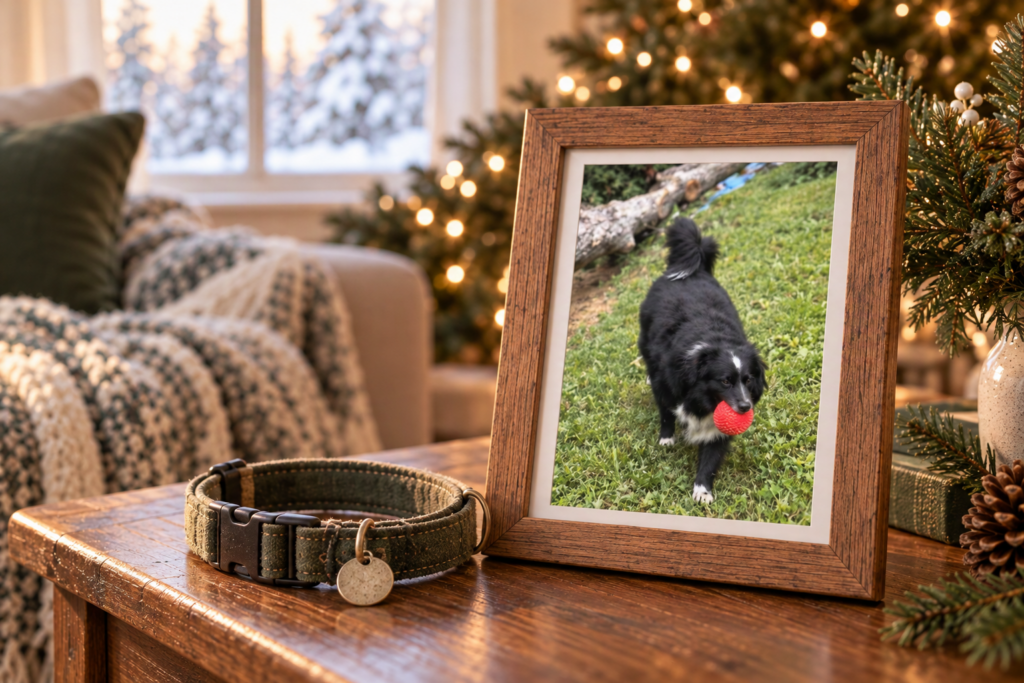
Pet loss and grief can feel especially difficult during the holidays.
The decorations come out, familiar routines return, and suddenly you notice all the little places where a beloved companion used to be.
Maybe there is an empty spot beside the tree. No familiar footsteps following you through the kitchen. No one waiting hopefully for something to fall while dinner is being prepared. A stocking does not get hung this year. A favorite holiday photograph suddenly means something different.
When a pet has been woven into everyday life, losing that companion means grieving more than their physical presence. We also miss the routines, the companionship, the sounds, and hundreds of ordinary moments we may never have realized were so important.
During the holidays, those little moments can feel very big.
Why losing a pet can hurt so deeply
Sometimes people hesitate to talk openly about pet loss and grief because they worry others will not understand how deeply they are hurting.
But the bond between people and companion animals can be profound.
The American Veterinary Medical Association recognizes that the grief surrounding an animal’s death can be similar to the grief experienced after losing a family member or close friend.
That is worth remembering, especially if someone has made you feel as though you should be “over it” by now.
There is no need to minimize your loss simply because the loved one you lost had paws, feathers, scales, or fur.
You loved someone who had become part of your life. Their presence mattered to you, and their absence does too.
When the house suddenly feels different
One of the hardest parts of grieving the loss of a pet can be the quiet that follows.
The empty bed. The leash hanging where it always hung. The food bowl that is no longer needed. The time of day when you would normally take a walk, prepare dinner, give medication, open the back door, or settle onto the couch together.
Sometimes your body remembers the routine before your mind has a chance to catch up.
You walk toward the door at the usual time. You glance toward a familiar sleeping spot. For a split second, you expect to hear the sound that always followed you into the next room.
The American Veterinary Medical Association describes something similar as the “presence of the absence.” When an animal has occupied both physical and emotional space in a home, suddenly not having that presence can make the silence surprisingly noticeable.
You do not have to immediately put everything away.
You also do not have to preserve everything exactly as it was.
There is no deadline for deciding what to do with a bed, a favorite toy, a collar, a blanket, or a food bowl. Give yourself time.
The holidays have a way of bringing memories closer
Pets quietly become part of our traditions.
They investigate the boxes when decorations come out. They sleep under or beside the tree. They appear in family photographs. They follow everyone through the kitchen. They greet visitors at the door. They travel with us, or wait for us to return.
And then one year, they are not there.
The University of Florida College of Veterinary Medicine notes that holidays, birthdays, anniversaries, and other special occasions can be especially challenging after a pet’s death because those days can remind us of experiences we once shared with that animal.
Sometimes it is not even a major tradition that catches us off guard.
It is realizing you automatically looked toward their usual spot while opening presents. It is finding an old holiday photograph on your phone. It is remembering how they reacted when guests arrived.
So if the holidays feel different this year, there is a reason.
Someone who was part of those moments is missing.
It is okay to make your pet part of the holiday
Remembering your pet does not mean you are refusing to move forward.
Sometimes making a little room for the memory can make the holiday gentler.
You might hang an ornament with a favorite photograph. Place a picture somewhere near the tree. Keep a collar or tag in a meaningful place. Donate food, blankets, or toys to a shelter or rescue organization in your pet’s memory.
Or you might simply tell a story.
The funny one everybody knows.
The Christmas when something got knocked over. The wrapping paper that never stood a chance. The food that disappeared from somewhere it definitely was not supposed to disappear from. The spot beside the tree that somehow belonged to your pet every year.
There does not need to be a formal ceremony.
Remembrance can be very simple.
Sometimes it is just saying their name.
Let yourself remember the whole story
Grief has a way of pulling our attention toward the end of a pet’s life, especially when there was illness, a difficult decision, or a goodbye we wish could have happened differently.
Those memories can be powerful.
But the ending was only one part of the story.
There were ordinary mornings. Walks. Naps. Toys. Car rides. Treats. Trips outside. Quiet evenings on the couch. Annoying habits that somehow became the very things you would give almost anything to experience one more time.
There were thousands of moments nobody photographed because nobody knew they needed to.
The American Veterinary Medical Association encourages people grieving a pet to continue that relationship through memories. Looking through photographs, writing a tribute, or even writing a letter to the pet you lost can give those memories somewhere to live.
Eventually, a photograph that makes you cry today may also make you smile.
One does not cancel out the other.
Grief does not move in a straight line
You can have a pretty good morning and then unexpectedly see an old photograph.
You may hear a familiar sound. Walk past the pet aisle at a store. Find a toy underneath a piece of furniture. Wake up one morning and briefly expect the old routine to begin.
Suddenly the loss feels close again.
That does not mean you have gone backward.
Cornell University College of Veterinary Medicine explains that there is no single “normal” way to grieve the loss of a companion animal and no prescribed timeline that everyone follows.
Grief can come and go. Some days will be easier than others. Sometimes a difficult moment appears without warning.
When one of those moments finds you, let it be a moment.
You do not have to fix it.
You are still allowed to have a good day
Grief can surprise us in the other direction, too.
You may laugh at dinner. You may enjoy opening gifts. You may become caught up in a conversation and realize that, for a little while, you simply had a good time.
Sometimes happiness is followed by guilt.
But enjoying a moment does not mean you loved your pet any less.
The University of Florida’s pet-loss guidance specifically reassures people that enjoying a holiday or special occasion is not a betrayal of the animal they lost.
You are not leaving them behind because you laughed.
You are not forgetting because you enjoyed Christmas dinner.
You can miss someone terribly and still have a good day.
Both can be true.
There is no need to rush what comes next
Eventually, someone may ask whether you are going to get another pet.
For some people, another animal eventually brings tremendous companionship and joy. For others, the idea is simply too difficult for a long time.
There is no universal answer and no correct amount of time to wait.
A new pet cannot replace the one who died because relationships are not interchangeable.
If another companion eventually comes into your life, that relationship gets to have its own story.
And if you are not ready, there is no reason you need to be.
Stay close to people who understand
One of the kindest things you can do for yourself is spend time with people who understand that the relationship you lost was important.
You do not necessarily need someone to explain grief to you. You may not need advice at all.
Sometimes you just need someone willing to listen to another story or look at another photograph.
Veterinarians may also be able to help connect people with pet-loss resources or support. Cornell University College of Veterinary Medicine maintains resources specifically for people grieving companion animals and emphasizes that no one needs to face grief alone.
If grief becomes overwhelming or begins seriously interfering with everyday life, there is nothing wrong with talking with a qualified mental health professional who understands bereavement and pet loss.
The love does not disappear when the routine does
One of the hardest things about losing a pet is that life keeps moving while part of your everyday world suddenly stops.
Eventually, you stop filling the food bowl.
You stop reaching for the leash.
You stop expecting to hear footsteps behind you.
Little by little, you become accustomed to walking through the door without the greeting that used to be waiting for you. “Hey there’s my dude” as they run up to greet you with eyes full of love.
But becoming accustomed to an absence is not the same thing as forgetting.
Maybe that is something worth holding onto during the holidays.
Keep the ornament if it brings comfort.
Tell the story.
Say the name.
Look at the pictures.
Remember the ridiculous things they did. Remember the routines that once seemed completely ordinary. Remember the quiet moments that nobody else ever saw.
If the holidays hurt a little more this year because someone with paws, feathers, scales, or fur is missing, be gentle with yourself.
They were part of your days.
They were part of your home.
They were part of your story.
They mattered. And that is why their absence matters, too.