
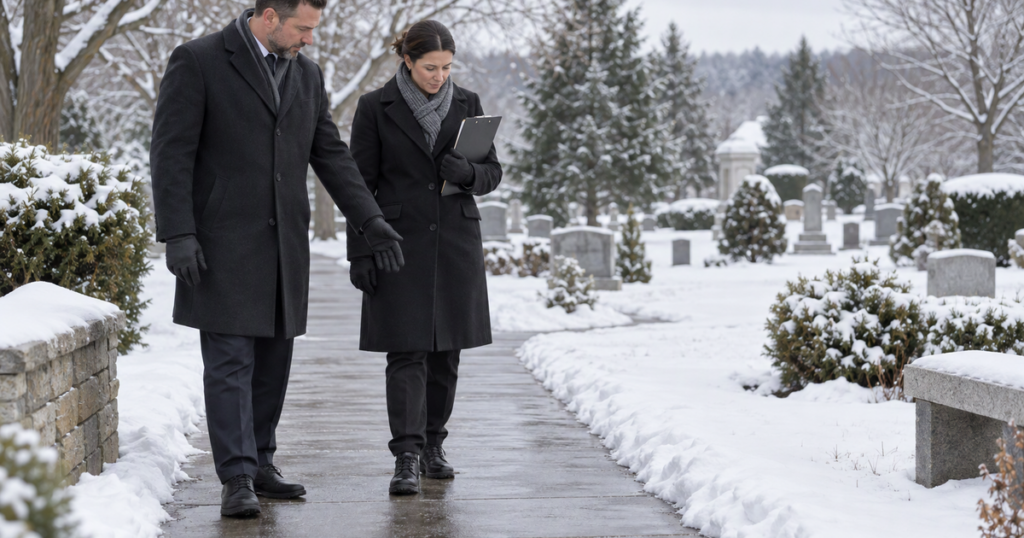
When the Weather Turns Cold: What Winter Means for Funeral Service Professionals
Cold weather changes the way many people approach the workday. For funeral service professionals, however, the work continues regardless of the forecast.
Funeral directors and other funeral service employees may move between a climate-controlled funeral home, a vehicle, a church or other service location, and an outdoor cemetery in the course of a single day. During the winter months, that can mean working around cold temperatures, wind, snow, ice, wet pavement, and rapidly changing conditions.
It is one of the practical realities future funeral service professionals should understand: serving families sometimes means working in conditions that are less than ideal, and professionalism includes being prepared for them.
Cold weather can affect funeral service through outdoor graveside work, transportation, slippery walking surfaces, employee exposure to the elements, and the needs of families attending services. While funeral service professionals cannot control the weather, they can prepare for the conditions they may encounter.
Funeral Service Does Not Always Happen Indoors
Much of the public-facing work of funeral service occurs indoors. Arrangements, visitations, preparation, ceremonies, administrative responsibilities, and conversations with families may all take place inside a funeral home or another climate-controlled building.
But funeral service is not exclusively an indoor profession.
Graveside and committal services obviously bring funeral professionals outdoors, but there can be other outdoor responsibilities as well. Funeral service employees may help organize a procession, load or unload vehicles, assist people entering or leaving a building, move equipment, prepare for a ceremony, or travel between locations.
Those responsibilities can feel very different in January than they do in May.
A cemetery that is relatively easy to navigate during warmer weather can present snow, ice, frozen ground, mud, or standing water during the winter. A parking lot or sidewalk can become slippery. A relatively mild air temperature can also feel considerably colder when wind and damp conditions are added.
The Occupational Safety and Health Administration notes that wind can cause the body to lose heat more rapidly. Wetness, dampness, improper clothing, and exhaustion can also contribute to cold stress. OSHA also explains that what constitutes cold stress can vary by region. In areas that are not accustomed to winter weather, temperatures near freezing may present cold-stress concerns.
That makes checking the weather more than a question of comfort. In funeral service, understanding the day’s conditions can become part of preparing for the work ahead.
How Does Cold Weather Change Funeral Service Preparation?
Cold weather can require funeral service professionals to think ahead about clothing, footwear, cemetery conditions, transportation, walking surfaces, and the needs of people attending an outdoor service.
Experienced funeral service professionals learn quickly that preparation matters. Winter adds several variables that may not exist during warmer parts of the year.
Questions to Ask Before an Outdoor Service
- What will the temperature and wind chill be during the graveside or committal service?
- Has snow, freezing rain, or ice affected the cemetery or funeral home?
- Are sidewalks, ramps, entrances, and parking areas clear?
- Is the ground at the cemetery wet, muddy, frozen, or snow-covered?
- Is employee footwear appropriate for the conditions?
- Does the staff have appropriate winter outerwear?
- Could snow or ice affect the funeral procession or other travel?
- Should additional travel time be allowed between locations?
- Are older adults or people with limited mobility likely to need additional assistance?
These may appear to be small details, but funeral service is built on details.
Families should be able to concentrate on the person they have lost and the meaning of the service. Good preparation helps keep preventable weather-related problems from becoming unnecessary distractions during an already important day.
Professional Appearance and Winter Clothing Can Work Together
Professional appearance remains important in funeral service, but winter demonstrates why professional dress also needs to be practical.
Clothing that works perfectly inside a funeral home may not provide enough protection during an extended period outdoors. A graveside service can require funeral service employees to remain outside and relatively stationary while assisting the family, coordinating the service, and attending to details.
That means funeral professionals may need to think about coats, gloves, hats, scarves, layers, and other cold-weather clothing while still maintaining the professional appearance expected in funeral service.
The National Institute for Occupational Safety and Health recommends several layers of loose clothing for people who must work in cold environments. NIOSH also recommends protecting the ears, face, hands, and feet.
For someone preparing to enter funeral service, there is a useful professional lesson here: looking professional and being practically prepared are not opposites.
In many situations, preparation is part of professionalism.
Winter Footwear Deserves Special Attention
Footwear is one of the most practical examples of how winter weather can affect funeral service employees.
Traditional dress shoes may look appropriate inside a funeral home but provide limited traction on snow, wet grass, mud, or ice. Cemetery terrain can also be uneven even when conditions are dry.
NIOSH recommends waterproof and insulated boots when people must work in cold and wet environments. Funeral establishments may have their own expectations regarding employee attire, but employees working outdoors should consider both professional appearance and the conditions they will encounter.
This can be particularly important during a graveside service. Employees may be walking across grass, pavement, snow, or uneven cemetery ground while also paying attention to the needs of other people.
The right footwear is not merely about being comfortable. It can help an employee move confidently and safely while performing the responsibilities of the job.
Ice and Snow Create Another Concern: Slips and Falls
Snow and ice can create slipping and tripping hazards around funeral homes, cemeteries, parking lots, entrances, ramps, and walkways.
Cold itself is only one winter concern.
Snow that melts during the day and refreezes later can create slick surfaces. Freezing rain can affect parking lots and roads. Snow may conceal uneven ground, curbs, or other changes in elevation.
These conditions are important in funeral service because funeral professionals are not thinking only about themselves.
The people attending a funeral or memorial service can represent many ages and levels of mobility. Some attendees may use a cane, walker, wheelchair, or other mobility aid. Others may simply be unfamiliar with the property or cemetery.
Something as ordinary as noticing an icy area before a family exits a vehicle can make a meaningful difference.
Think About the Entire Walking Route
Winter preparation may need to extend beyond clearing the primary entrance to a funeral home.
Funeral service employees may need to pay attention to parking areas, sidewalks, steps, ramps, building entrances, loading areas, and the routes people use when moving between vehicles and buildings.
At a cemetery, conditions may be outside the direct control of funeral home personnel. That makes situational awareness especially important.
Funeral professionals may arrive before a family or procession and encounter conditions that have changed since the service was planned. Recognizing those conditions early gives employees more time to determine how to proceed safely and efficiently.
Cold Stress Is a Real Workplace Safety Issue
Cold stress can affect people who work outdoors or in cold environments, including employees whose jobs only require outdoor work for part of the day.
Funeral service professionals who have responsibilities outdoors should understand that cold exposure can become more than an issue of discomfort.
The Centers for Disease Control and Prevention and NIOSH identify several cold-related illnesses and injuries that can affect workers, including hypothermia, frostbite, trench foot, and chilblains.
Hypothermia occurs when the body loses heat faster than it can produce heat. Early warning signs can include shivering, fatigue, loss of coordination, confusion, and disorientation.
The risk is not limited to occupations people typically associate with spending an entire workday outdoors. OSHA states that environmental cold can affect any worker exposed to cold air temperatures.
Wind can increase heat loss from the body, while wet or damp clothing can also contribute to heat loss. That is particularly relevant when winter conditions include rain, sleet, melting snow, or wet cemetery grounds.
What Can Help Reduce Cold-Stress Risk?
NIOSH recommends several practical measures for employees and employers when working in cold environments. These include wearing appropriate clothing, using several loose layers for insulation, protecting the face and extremities, moving into warm locations during breaks, limiting time outdoors during extreme cold, and monitoring personal condition and coworkers for signs of cold stress.
NIOSH also recommends that employers consider scheduling cold-weather work during warmer portions of the day when possible, using additional workers for long jobs, providing warm liquids, and providing warm areas for breaks.
Funeral establishments will have their own policies, circumstances, and responsibilities, but awareness of cold-weather hazards is part of approaching workplace safety seriously.
Winter Weather Can Affect Transportation, Too
Snow, freezing rain, reduced visibility, and icy roads can affect removals, funeral processions, cemetery travel, and other transportation responsibilities in funeral service.
Transportation is part of the profession that prospective students may not immediately think about.
Funeral service professionals may travel to residences, hospitals, nursing facilities, hospices, churches, cemeteries, crematories, airports, and other locations during the course of their work.
A funeral procession can also involve numerous vehicles traveling together between a place of service and a cemetery.
During winter, conditions that would ordinarily make transportation routine can change quickly.
Preparation Begins Before the Vehicle Moves
Allowing additional travel time, paying attention to changing forecasts and road conditions, keeping vehicles ready for winter operation, and communicating when conditions could affect schedules can all become important parts of the day.
Funeral professionals may also have to consider the people following a procession. Some drivers may be unfamiliar with the route, uncomfortable driving in winter weather, or operating vehicles that handle snow and ice differently.
This highlights something students eventually discover about funeral service: adaptability is a professional skill.
A schedule may be carefully planned, but funeral professionals cannot control the weather. They can control how well they prepare for it and how professionally they respond when conditions change.
Families Experience the Weather, Too
Winter preparedness in funeral service is not only about employees. Families, friends, pallbearers, clergy, cemetery personnel, and other people participating in a service are experiencing the same conditions.
Some attendees may be older adults. Others may have medical conditions or mobility limitations. Someone may arrive dressed appropriately for an indoor funeral without realizing that part of the service will take place outdoors.
A thoughtful funeral professional notices those circumstances.
That could mean providing clear information before leaving for the cemetery, helping someone identify safer footing, keeping an outdoor portion of the service organized, recognizing changing weather conditions, or simply noticing when someone may need additional assistance.
These actions may never appear on a funeral program.
Families may never know how much preparation happened behind the scenes before they arrived.
But behind-the-scenes preparation is a significant part of funeral service.
Weather Can Change Quickly During a Funeral Service
One of the challenges of winter weather is that conditions do not always remain the same throughout the day.
A morning may begin with dry pavement and temperatures above freezing. A few hours later, falling temperatures, rain, sleet, snow, or increasing wind can create very different conditions.
A funeral professional preparing for the entire day therefore needs to think beyond the weather at the moment they leave home or arrive at the funeral home.
The forecast during the time of a graveside service may matter more than the conditions early that morning.
This is another example of the practical thinking involved in funeral service. Professionals often have to anticipate what may happen next rather than simply respond to what is happening at that moment.
Funeral Service Requires Practical Problem-Solving
Students considering funeral service understandably spend a lot of time thinking about the major responsibilities of the profession: caring for deceased individuals, arranging services, working with families, coordinating ceremonies, understanding applicable laws and regulations, and learning the business side of funeral service.
Winter weather provides a useful example of another skill the profession requires: practical problem-solving.
A funeral professional may have a carefully planned day and then encounter six inches of snow, freezing rain, difficult driving conditions, a delayed cemetery schedule, a slippery walkway, or a family member who needs additional assistance safely reaching a graveside.
The professional response is not simply, “The weather is bad.”
The question becomes: “How do we safely and respectfully take care of the family despite the weather?”
That mindset extends far beyond winter.
Funeral service professionals regularly work in situations where circumstances can change. Families may have unexpected needs. Schedules can change. Transportation can be delayed. A ceremony may require last-minute adjustments.
Learning to remain calm, identify the problem, communicate clearly, and determine a practical next step is valuable throughout a funeral service career.
Winter Shows Why Attention to Detail Matters
Funeral service is a profession in which details matter because those details affect real people during important moments in their lives.
Winter simply makes some of those details easier to see.
Did someone check the walkway?
Is the cemetery accessible?
Did the staff allow additional travel time?
Are employees dressed appropriately for the outdoor portion of the service?
Has someone considered how an older family member will safely reach the graveside?
What happens if the weather changes?
None of these questions individually defines funeral service. Together, however, they demonstrate the level of preparation and awareness the profession can require.
Learning About the Real Work of Funeral Service
For prospective students, understanding funeral service means understanding both its meaningful responsibilities and its everyday realities.
Some days may involve arrangements, ceremonies, paperwork, preparation, transportation, or conversations with families.
Other days may include standing at a cemetery in a cold wind while making sure a service proceeds as smoothly as possible.
Both are funeral service.
Preparation, attention to detail, adaptability, safety, and care for others are not separate from professionalism. They are part of it.
Considering a Career in Funeral Service?
A funeral service education can help students better understand the professional, technical, ethical, and practical responsibilities that come with serving families.
Those considering the profession can learn more about funeral service education through Pierce College of Funeral Service and its schools: Dallas Institute of Funeral Service, Gupton-Jones College of Funeral Service, and Mid-America College of Funeral Service.
Exploring funeral service education is an opportunity to learn not only what funeral professionals do, but also the preparation, adaptability, attention to detail, and commitment to service the profession requires.
Frequently Asked Questions About Cold Weather and Funeral Service
Do funeral directors work outside during the winter?
Yes. Depending on their responsibilities, funeral service professionals may work outdoors during graveside and committal services, around funeral vehicles, during processions, and while assisting families and other attendees entering or leaving locations.
Can funeral service employees experience cold stress?
Yes. OSHA states that environmental cold can affect any worker exposed to cold air temperatures. Wind, dampness, inappropriate clothing, and prolonged exposure can increase the risk of cold stress.
What should workers wear when working outdoors in cold weather?
NIOSH recommends wearing several layers of loose clothing when working in cold environments and protecting the ears, face, hands, and feet. Waterproof, insulated footwear may also be appropriate when conditions are cold and wet. Funeral service employees should also follow their employer’s dress and safety policies.
Why is winter preparation important for funeral homes?
Winter weather can affect outdoor services, transportation, sidewalks and entrances, cemetery conditions, and the comfort and safety of employees and people attending services. Preparing for those conditions can help funeral professionals continue serving families safely and professionally when the weather changes.