If you’re exploring a career in funeral service, you’ve likely come across two common professional roles: funeral director and embalmer. While these careers often work closely together, they are not the same. Understanding the differences can help prospective students determine which path best aligns with their interests, skills, and career goals.
In simple terms, funeral directors focus primarily on helping families plan and coordinate funeral services, while embalmers concentrate on the preparation and care of the deceased. However, the distinction is not always clear-cut. In some states, professionals may hold licenses in both disciplines and perform responsibilities across both areas of funeral service.
What Does a Funeral Director Do?
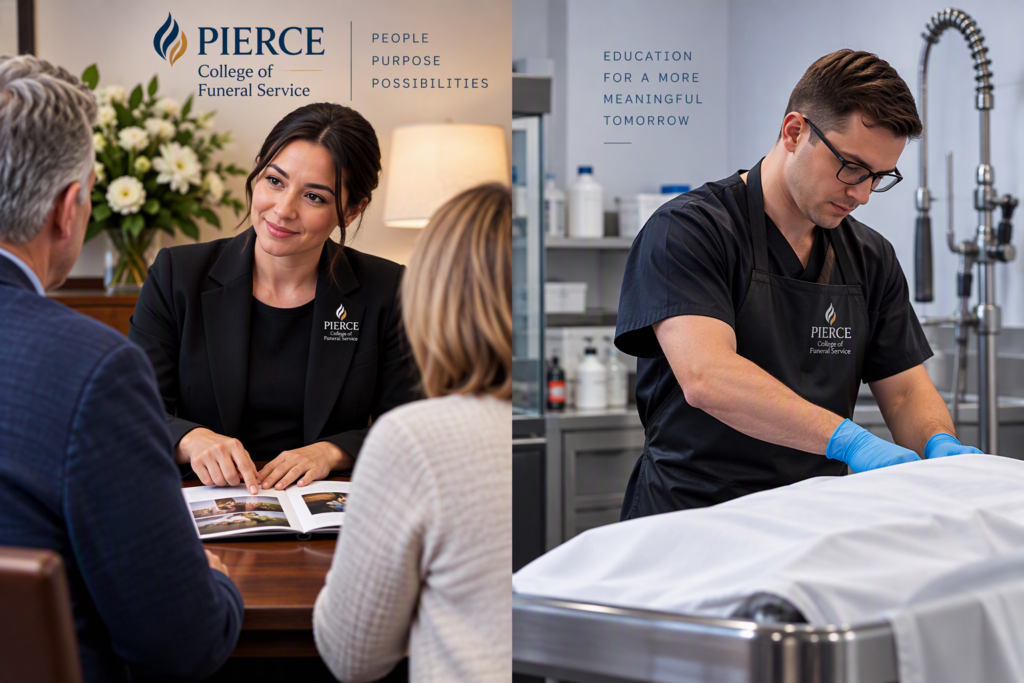
A funeral director works directly with families during one of the most challenging times in their lives. Their role combines compassion, communication, organization, and attention to detail.
Common responsibilities of a funeral director may include:
- Meeting with families to discuss funeral or memorial arrangements
- Explaining service options and related documentation
- Coordinating visitations, ceremonies, and memorial events
- Working with clergy, celebrants, cemeteries, crematories, and other service providers
- Preparing legal documents such as death certificates and permits
- Managing administrative and business operations within a funeral home
- Supporting families throughout the planning process
Because funeral directors interact extensively with the public, strong interpersonal skills are often just as important as technical knowledge.
What Does an Embalmer Do?
An embalmer is responsible for preparing and caring for the deceased in accordance with professional practices, legal requirements, and the wishes of the family.
Typical embalmer responsibilities may include:
- Preparing remains for viewing and visitation
- Performing embalming procedures when authorized and appropriate
- Applying restorative techniques when needed
- Maintaining preparation rooms and equipment
- Following health, safety, and regulatory requirements
- Documenting preparation procedures and case records
- Assisting with transportation and care of the deceased
Embalmers often work behind the scenes and focus on technical, scientific, and restorative aspects of funeral service.
Funeral Director vs. Embalmer: Key Differences
Although both professionals serve an essential role in funeral service, their day-to-day responsibilities differ significantly.
Family Interaction
Funeral directors typically spend much of their time meeting with families, discussing arrangements, and coordinating services. Embalmers generally have less direct interaction with families and spend more time in preparation and care settings.
Primary Focus
Funeral directors focus on service planning, family support, communication, and administration. Embalmers focus on preparation, preservation, restorative work, and technical procedures.
Skills Required
Successful funeral directors often excel in communication, organization, customer service, and problem-solving. Successful embalmers often have strong attention to detail, scientific aptitude, technical skills, and an understanding of human anatomy.
Work Environment
Funeral directors may divide their time between offices, chapels, arrangement rooms, services, and community events. Embalmers typically spend more time in preparation areas and mortuary facilities.
Can One Person Be Both a Funeral Director and an Embalmer?
Yes. In many areas of the United States, funeral service professionals pursue education and training that prepares them for both funeral directing and embalming responsibilities.
The exact licensing structure varies by state. Some states issue separate licenses for funeral directing and embalming, while others have different licensing frameworks. Because requirements can change and differ by jurisdiction, students should always consult the state licensing board where they intend to practice.
Holding qualifications in both disciplines may provide additional flexibility and a broader understanding of funeral home operations.
Which Career Path Is Right for You?
Choosing between funeral directing and embalming often comes down to your interests, strengths, and preferred work environment.
You May Enjoy Funeral Directing If You:
- Like working directly with people
- Enjoy planning and organizing events
- Have strong communication skills
- Want to guide families through important decisions
- Are interested in business and management responsibilities
You May Enjoy Embalming If You:
- Prefer technical and scientific work
- Have strong attention to detail
- Enjoy anatomy and restorative practices
- Like working behind the scenes
- Value precision and procedural consistency
Many professionals discover they appreciate aspects of both roles and choose educational pathways that expose them to the full range of funeral service responsibilities.
What Do Students Learn in Funeral Service Education?
Funeral service education programs are designed to provide foundational knowledge across multiple areas of the profession. Students may study subjects such as:
- Funeral directing
- Embalming theory and practice
- Restorative art
- Anatomy and pathology
- Grief support and counseling concepts
- Funeral service law and ethics
- Business management
- Communication and professional conduct
This broad educational foundation can help students better understand both career paths before deciding how they want to focus their professional development.
The Shared Mission Behind Both Careers
While funeral directors and embalmers perform different responsibilities, they share a common purpose: serving families with professionalism, dignity, and care.
One role focuses primarily on supporting families through planning and decision-making. The other focuses on preparing and caring for the deceased. Together, these professionals help create meaningful services and experiences for the communities they serve.
Frequently Asked Questions
Is a funeral director the same as an embalmer?
No. Funeral directors primarily coordinate arrangements and work with families, while embalmers focus on preparing and caring for the deceased.
Can funeral directors perform embalming?
Depending on state licensing requirements and professional qualifications, some funeral directors may also be licensed to perform embalming.
Which career has more interaction with families?
Funeral directors generally have more direct interaction with families throughout the arrangement and service process.
Do I have to choose one career path immediately?
Not necessarily. Many funeral service education programs introduce students to both disciplines, allowing them to explore the profession before making career decisions.
Final Thoughts
Understanding the difference between a funeral director and an embalmer is an important first step for anyone considering a future in funeral service. Whether you are drawn to supporting families directly, working in a more technical environment, or pursuing a combination of both, funeral service offers opportunities to develop meaningful professional skills while serving your community.
Students researching funeral service education should review state licensing requirements and explore educational programs that provide a strong foundation across the profession’s key disciplines.