
5 Questions to Ask Before Choosing a Funeral Service College
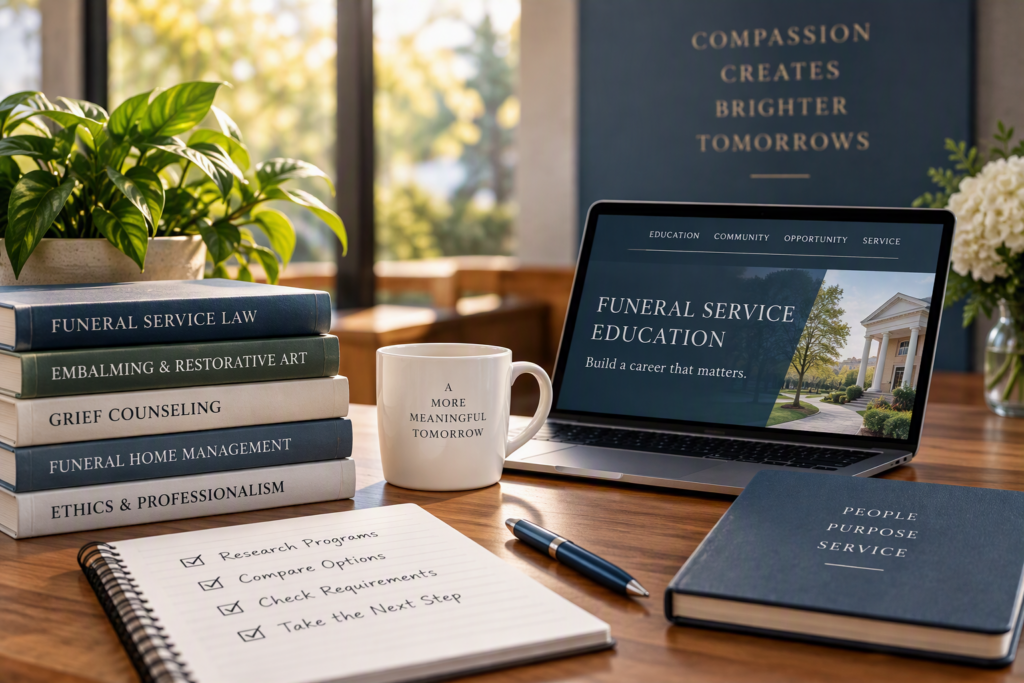
Choosing a funeral service college means looking at more than location or tuition. Accreditation, state licensing requirements, curriculum, hands-on clinical experience, learning format, transfer-credit policies, and admissions requirements can all affect which program is right for you.
If you are considering funeral service education, you may already know that specialized education will be part of your journey. The more difficult question can be deciding where and how to complete that education.
This decision can be especially important for adults balancing college with employment, family, caregiving, or other responsibilities. A traditional on-campus program may work well for one student, while another may need the flexibility of a hybrid program that combines virtual coursework with required hands-on experiences.
Before choosing a funeral service college, here are five practical questions to ask, along with a closer look at how these considerations apply at Pierce College of Funeral Service.
1. Is the Funeral Service Program Accredited?
Accreditation should be one of the first things you investigate when comparing funeral service programs.
The American Board of Funeral Service Education, or ABFSE, provides accreditation for funeral service and mortuary science education programs. Prospective students can use the ABFSE Directory of Accredited Programs to research programs and verify current accreditation information.
The funeral service programs at Dallas Institute of Funeral Service, Gupton-Jones College of Funeral Service, and Mid-America College of Funeral Service are identified in current Pierce materials as ABFSE-accredited programs.
Accreditation is something prospective students should verify rather than assume. A school may offer education related to funeral service without every program having the same accreditation status.
There is another important distinction to understand: accreditation and professional licensure are related, but they are not the same thing. State licensing requirements can differ, which leads to an equally important question.
2. Will the Program Work for the State Where You Want to Practice?
Funeral service licensing requirements vary by state, so one of the most important questions to answer before enrolling is where you intend to pursue professional licensure.
This matters whether you plan to attend college on campus or through a program that includes distance education.
Pierce advises prospective students to contact the funeral service licensing agency in the state where they intend to practice. Individual states establish their own requirements for professional funeral service licensure, and some states may have requirements that need to be addressed before attending funeral service college.
This is particularly important if you live in one state, attend a program based in another, and ultimately intend to seek licensure somewhere else.
Before enrolling, consider asking:
- What educational requirements does my state have?
- Are there requirements I must satisfy before or while attending college?
- What examinations or practical experience does my state require?
- Does the program I am considering align with the requirements of the state where I intend to practice?
The funeral service licensing agency for the state where you intend to practice should be consulted for current licensing requirements.
3. What Will You Actually Study and Complete?
A funeral service degree combines academic coursework with specialized professional education and hands-on requirements, so look beyond the name of the degree and examine what the program actually includes.
Pierce offers an Associate of Applied Science in Funeral Service. The curriculum includes both theoretical and practical areas of funeral service education.
Current Pierce program information identifies courses including Embalming Theory and Lab, Funeral Service Law, Restorative Art, Grief Counseling, and Funeral Home Management.
That range is important because funeral service education is not limited to one technical skill. The curriculum brings together scientific, technical, legal, interpersonal, and business-related areas associated with professional funeral service.
What Kind of Hands-On Experience Is Part of the Program?
Clinical and laboratory requirements are an important part of funeral service education.
At Pierce, students encounter practical requirements including Embalming Clinical Case, Funeral Directing Practicum, and Restorative Art Laboratory requirements.
These requirements are also connected with progression through the program. Current Pierce information for the final capstone sequence states that students must complete the required academic coursework as well as the Embalming Clinical Case, Funeral Directing Practicum, and Restorative Art Laboratory requirements before entering the capstone sequence.
When comparing funeral service colleges, examine both the course list and the practical requirements. A program title tells you the degree being offered. The individual courses, laboratories, clinical cases, and practicum experiences provide a much clearer picture of the education you will actually complete.
4. Does the Learning Format Fit Your Life?
For students balancing college with work, family, caregiving, or distance from campus, understanding exactly how a program is delivered can be just as important as understanding what courses it includes.
At Pierce College of Funeral Service, students can explore a traditional on-campus educational experience as well as a hybrid Associate of Applied Science in Funeral Service program.
How Does Pierce’s Hybrid Funeral Service Program Work?
In the hybrid Associate of Applied Science in Funeral Service program, most coursework can be completed virtually through Blackboard.
Hybrid, however, does not mean that the entire funeral service program is completed online. Hands-on education remains part of the program.
Under the current hybrid program structure, students complete 12 embalmings. Of those cases, 11 are completed at a local funeral home.
The final embalming is completed on campus during the sixth quarter. Students also complete the final restorative art laboratory requirement on campus during the sixth quarter.
Under the current program structure, hybrid students are on campus for approximately four total days.
That provides a more useful definition of what “hybrid” means at Pierce: most coursework can be completed virtually through Blackboard, while specific clinical and laboratory requirements remain hands-on.
What Should You Ask About an Online or Hybrid Funeral Service Program?
Instead of simply asking whether a funeral service program is “online,” ask questions that clarify how the program will actually fit into your life:
- How much of the coursework can be completed virtually?
- Which clinical or laboratory experiences must be completed in person?
- Can clinical requirements be completed at a funeral home near where I live?
- How often will I need to travel to campus?
- During which part of the program will the on-campus requirements occur?
- What learning platform is used for virtual coursework?
For someone deciding whether funeral service education can realistically fit around employment or family responsibilities, those details can be much more useful than a simple “online” or “on-campus” label.
5. What Happens to College Credits You Already Have?
If you have attended college before, ask for an official transfer-credit evaluation rather than assuming that previous coursework will or will not transfer.
This question can be particularly important for career changers and adults returning to college who already have previous coursework on their transcripts.
Under Pierce’s current transfer-credit policy, qualifying credits from regionally accredited institutions may be accepted when the applicable criteria are met. Eligible transfer courses generally require an official transcript showing a minimum grade of C or its equivalent.
Do Older English and Math Credits Transfer?
Current Pierce transfer information states that ENG 100 English Grammar and Composition and MAT 100 Mathematics for Business may be accepted regardless of the time elapsed since the courses were completed, provided the other transfer requirements are satisfied and the official transcript shows a minimum grade of C or equivalent.
Are Some Transfer Courses Time-Sensitive?
Yes. Pierce identifies certain courses as time-sensitive for transfer purposes. These courses must have been completed within the four years before transfer and meet the applicable minimum grade requirement.
Examples listed in current Pierce materials include SCI 100, TEC 101, SCI 202, SCI 222, MGMT 101, SCI 102, and LAW 203.
Can Funeral Service Core Courses Transfer?
Current Pierce transfer policy does not accept transfer credit for Funeral Service Core (COR) or Capstone (CAP) courses because of the specialized nature of the curriculum.
Transfer applicants should provide official transcripts from all previously attended postsecondary institutions so their records can be formally reviewed.
Accepted transfer credit may affect the coursework a student has remaining and may affect program length, but the result depends on the individual transfer evaluation, program requirements, course sequencing, and schedule.
What Do You Need to Enroll at Pierce?
The core Pierce admissions process includes choosing your desired program, completing an application and required enrollment documents, meeting the educational and age requirements, and submitting required official records and identification.
The core admissions requirements are generally shared by Dallas Institute of Funeral Service, Gupton-Jones College of Funeral Service, and Mid-America College of Funeral Service, although some school-specific requirements apply.
Under current Pierce admissions requirements, prospective students should be prepared to:
- Choose the school and program you intend to pursue.
- Complete an application for the desired program.
- Be at least 18 years old by the program start date.
- Complete the required enrollment documents through DocuSign.
- Provide official high school graduation, GED, or approved equivalent documentation.
- Submit official transcripts from any previously attended postsecondary institutions, if they contain transfer classes that are applicable.
- Provide a recent photograph for identification purposes. A driver’s license or state-issued identification card is preferred.
Official transcripts must be sent directly to the college from the issuing school, institution, certifier, or approved transcript service.
Is There an Application Fee?
Yes. The standard Pierce application fee is $50 and is normally non-refundable. For November 2026, however, Pierce is removing that cost for prospective students during a special application-fee waiver period.
From November 1 through November 30, 2026, Pierce College of Funeral Service is waiving the standard $50 application fee.
Prospective students interested in Dallas Institute of Funeral Service, Gupton-Jones College of Funeral Service, or Mid-America College of Funeral Service can begin the application process during the November promotional period without paying the standard $50 application fee.
Does Pierce Require the SAT, ACT, or Wonderlic for Admission?
No. A standardized entrance examination is not currently required for admission at Dallas Institute of Funeral Service, Gupton-Jones College of Funeral Service, or Mid-America College of Funeral Service.
The colleges removed the previous standardized entrance-assessment requirement. Applicants are not currently required to complete a Wonderlic, SAT, ACT, or equivalent standardized entrance examination for admission.
This is an important distinction for prospective students researching Pierce online because older admissions information may still refer to entrance assessments.
Are the Admissions Requirements Identical at All Three Schools?
The core admissions requirements are generally the same, but some school-specific requirements apply.
For example, current admissions materials for Dallas Institute of Funeral Service and Mid-America College of Funeral Service list documentation of bacterial meningitis immunization or an approved exemption. The current Gupton-Jones College of Funeral Service admissions addendum does not list meningitis documentation among its requirements.
Applicants should therefore review the current requirements for the specific school they intend to attend rather than assuming every admissions requirement is identical at all three schools.
What Happens After You Apply?
Applicants should choose their school and desired program and complete the online application. The required admissions documents are then submitted so the Admissions Office can review the file.
After the application and all required admissions documentation have been received, the Admissions Office reviews the application and makes an admissions decision.
If additional documentation is required, an applicant may be contacted before a final decision can be made.
Pierce recommends applying as far in advance of the intended enrollment date as possible. Doing so allows time for the application to be processed, official transcripts to arrive, enrollment documents to be completed, and missing items to be resolved.
Which Pierce School Should You Choose?
Pierce College of Funeral Service includes Dallas Institute of Funeral Service, Gupton-Jones College of Funeral Service, and Mid-America College of Funeral Service.
The appropriate choice can depend on your location, program preference, preferred learning format, and the licensing requirements associated with the state where you intend to practice.
Prospective students who are unsure which option fits their circumstances can speak with Admissions about programs, requirements, timelines, and next steps.
What Should International Students Know?
There is an additional consideration for prospective international students who require F-1 enrollment.
Gupton-Jones College of Funeral Service is the Pierce school identified as SEVIS F-1 approved. Current Pierce admissions materials state that Dallas Institute of Funeral Service and Mid-America College of Funeral Service are not SEVIS-approved for students who require F-1 support.
International applicants requiring F-1 enrollment should therefore work with Gupton-Jones Admissions regarding the admissions process and additional immigration-documentation steps.
Ready to Take the Next Step? Apply November 1–30 With No Application Fee
Choosing a funeral service college deserves careful research. Accreditation matters. So do state licensing requirements, curriculum, hands-on clinical experiences, learning format, admissions requirements, and the transferability of college credit you may have already earned.
Once you understand those pieces, the next step becomes much clearer: choose the program that aligns with your goals and begin the application process.
From November 1 through November 30, 2026, Pierce College of Funeral Service is waiving the standard $50 application fee.
If you have been considering funeral service education, November is an opportunity to move from researching your options to beginning the admissions process. You can use the time before applying to gather your educational records, review the licensing requirements for the state where you intend to practice, and compare the Pierce programs available to you.
Explore Dallas Institute of Funeral Service, Gupton-Jones College of Funeral Service, or Mid-America College of Funeral Service and submit your application between November 1 and November 30, 2026, to take advantage of the application-fee waiver.