The Art of Restoration: Why Restorative Art Is Essential to Funeral Service Education
For many families, seeing a loved one for the final time becomes an important part of saying goodbye. They may carry that final image with them for years. Creating a peaceful, familiar appearance therefore requires far more than cosmetics. It demands scientific knowledge, artistic judgment, technical preparation, careful observation, and a deep understanding of the responsibility entrusted to funeral service professionals.
That is why restorative art in funeral service is such an important part of a funeral professional’s education. Restorative art brings together anatomy, embalming, color theory, modeling, cosmetology, lighting, and other specialized techniques. Each skill supports the same purpose: caring for the deceased respectfully while helping a family experience a more comforting and meaningful farewell.
At Pierce Mortuary Colleges, restorative art is not treated as an isolated creative exercise. It is part of the broader technical and compassionate preparation within the Associate of Applied Science in Funeral Service program. Through structured coursework and applied laboratory experiences, students begin developing the knowledge, judgment, and practical abilities required for the real responsibilities of funeral service.
What Is Restorative Art in Funeral Service?
Restorative art is the study and practice of recreating a natural, recognizable appearance when illness, injury, trauma, decomposition, medical procedures, or other physical changes have altered the features of the deceased. The work can range from subtle corrections in color or facial expression to more advanced reconstruction.
The word “art” is appropriate because the practitioner must understand proportion, form, texture, light, shadow, and color. Yet restorative art is equally grounded in science. A student cannot accurately restore a feature without understanding the anatomical structures that give it shape. Nor can restorative work be separated from embalming, sanitation, chemistry, pathology, and the individual condition of the deceased.
Depending on the circumstances and the family’s wishes, restorative preparation may involve:
- Correcting minor discoloration or changes in complexion
- Reestablishing natural facial contours
- Creating a more familiar and restful expression
- Using wax or other materials to model damaged or missing tissue
- Restoring features affected by illness, injury, or medical intervention
- Applying cosmetics that account for skin tone, lighting, and the viewing environment
- Working from photographs and family guidance to recreate characteristic details
Not every case requires extensive reconstruction. In fact, much of restorative art depends on recognizing small details. The curve of the mouth, the position of the eyelids, the contour of the cheeks, the texture of the skin, or the balance of color can influence whether an appearance feels natural and familiar.
Learning to see and evaluate those details is one of the most important abilities a funeral service student can develop.
Why Restorative Art Matters to Families
A viewing is not simply a visual event. It can be an emotional moment in which the reality of a death is acknowledged and a family has an opportunity to gather, remember, and say goodbye.
Every person experiences grief differently, and viewing is not the right choice for every family. When a family does choose it, however, the preparation of their loved one deserves exceptional care.
Families often hope to see someone they recognize—not an image defined by the person’s final illness, an accident, or a difficult medical experience. Thoughtful restorative work can help shift attention away from those circumstances and back toward the individual’s identity.
The goal is not to erase reality or create an artificial appearance. It is to use professional knowledge respectfully so that the presentation supports the family’s wishes and the dignity of the deceased.
A successful restoration should rarely call attention to the work itself. Ideally, it allows the person—not the technique—to remain at the center of the farewell.
The National Funeral Directors Association’s educational resources continue to emphasize the relevance of restorative art, including the assessment of traumatic injuries and the possibility of viewing in difficult cases. That continuing professional attention reflects an important truth: restorative art is not a dated or merely cosmetic practice. It remains a meaningful service to families.
Where Science and Art Meet
Restorative art is sometimes misunderstood as a talent someone either naturally possesses or does not. Artistic awareness can certainly help, but professional competence is developed through education, practice, critique, and repetition.
Students learn principles they can apply methodically instead of relying on instinct alone.
Anatomy Creates the Foundation
Before reconstructing a facial feature, students must understand what lies beneath it. Bones, muscles, cartilage, fatty tissue, and the natural landmarks of the face all contribute to a person’s appearance.
Anatomical knowledge helps a practitioner determine correct placement, proportion, projection, and symmetry.
This is one reason restorative art belongs within a comprehensive funeral service curriculum. Anatomy is not merely information to memorize for an examination. It becomes practical knowledge that guides feature modeling, tissue restoration, and the evaluation of facial form.
Color Theory Supports a Natural Appearance
Color is more complex than selecting a cosmetic shade. The practitioner must evaluate the existing condition of the tissue, recognize discoloration, understand how colors interact, and anticipate how preparation-room and viewing-room lighting will affect the final appearance.
Students learn that color can be adjusted through complementary relationships, layering, blending, and careful application.
Skin also contains variation. A flat, uniform color rarely looks natural, so effective cosmetology requires restraint, observation, and an understanding of how subtle tones work together.
Modeling Recreates Form and Dimension
Restoration may require building or refining contours with specialized materials. This work demands an understanding of depth, surface texture, bilateral form, and the way light falls across the face.
A feature that appears correct from one angle may look unnatural from another, making continual assessment essential.
Students need opportunities to translate a two-dimensional photograph or an anatomical concept into a three-dimensional form. That translation is a learned technical process—one strengthened through guided practice.
Embalming and Restoration Work Together
Restorative art does not begin only after embalming is complete. The embalmer must assess the condition of the body, anticipate restorative needs, and make preparation decisions that support the intended result.
Preservation, tissue condition, positioning, feature setting, and restoration are interconnected.
Understanding that relationship helps students think beyond a list of separate procedures. It encourages them to develop a complete case plan and consider how one decision may affect every step that follows.
Why Hands-On Restorative Art Training Is Critical
A textbook can explain facial proportions. A lecture can demonstrate color relationships. A photograph can show the result of a successful restoration.
None of those experiences, by itself, can fully replace the process of working with materials, evaluating form from multiple angles, correcting an application, and trying again.
Hands-on instruction gives students the opportunity to connect theory with physical technique. They learn how materials respond, how much pressure to use, how colors change when blended, and how small alterations can affect the overall appearance.
Just as importantly, they learn to slow down, assess their work honestly, and make deliberate corrections.
Practice also builds confidence. A student’s first attempt at modeling a feature may feel unfamiliar. With demonstration, repetition, and feedback, the process becomes more understandable.
Students begin to recognize why a result appears incorrect and what adjustment might improve it. That growth from uncertainty to informed decision-making is one of the central purposes of laboratory education.
Hands-on training also teaches that difficult cases rarely have one universal solution. The funeral professional must consider the condition of the deceased, available reference photographs, the family’s expectations, the time available, the viewing environment, and the limits of what can be achieved responsibly.
Technical ability matters, but so do judgment and communication.
The Responsibility Behind the Technique
Restorative art is performed at a time when families may feel vulnerable, exhausted, and overwhelmed. That reality places ethical responsibility behind every technical decision.
Funeral professionals must communicate honestly about what may be possible. They should listen carefully to the family’s concerns, invite appropriate photographs or guidance, and avoid creating expectations that cannot be met.
Permission, confidentiality, respectful handling, and professional boundaries remain essential throughout the process.
Students must also understand that personal preference is not the standard. The goal is not to create the practitioner’s idea of an ideal appearance. It is to preserve individuality and, when restoration is requested, work toward an appearance consistent with the person the family remembers.
This requires humility. Even an experienced practitioner continues learning because every person and every case is different.
Strong funeral service education helps students develop both the courage to apply their skills and the wisdom to recognize when they need guidance from a more experienced professional.
How Pierce Prepares Students Through Restorative Art Education
Pierce Mortuary Colleges’ Associate of Applied Science in Funeral Service is structured to develop the technical and interpersonal abilities needed in the profession.
Restorative Art is included alongside subjects such as Embalming Theory and Lab, Funeral Service Law, Grief Counseling, and Funeral Home Management.
That breadth is important. A funeral professional may move from the preparation room to an arrangement conference, coordinate a ceremony, complete legal documentation, supervise staff, and support a grieving family—all while maintaining high ethical and professional standards.
Restorative ability is strongest when it is supported by the rest of that education.
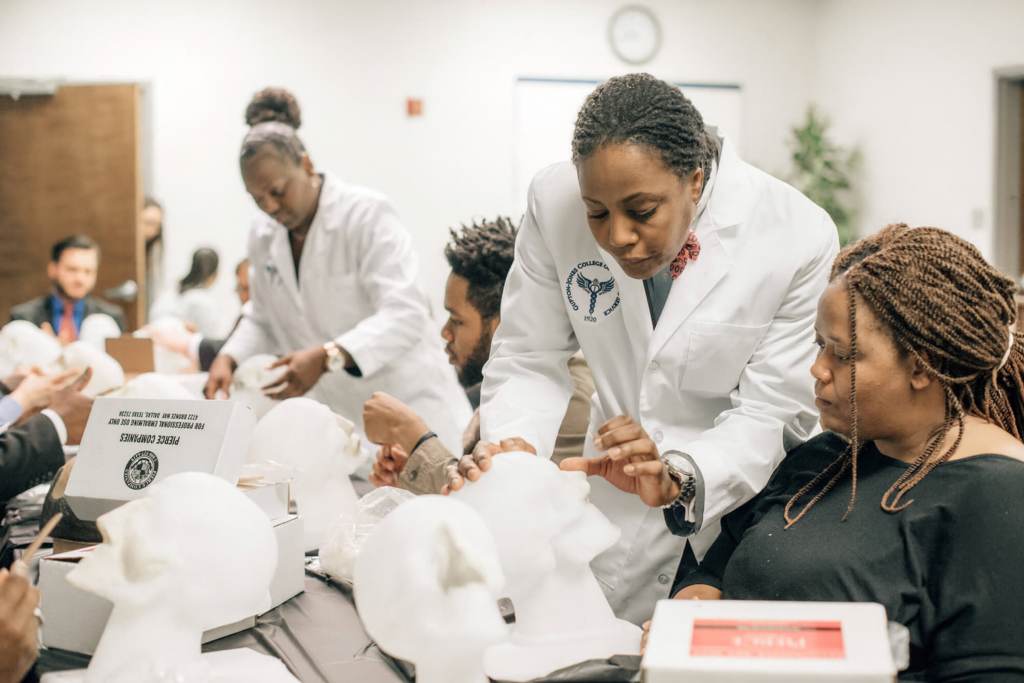
Pierce’s Restorative Art Lab provides hands-on training in anatomical restoration, feature modeling, and cosmetic applications used in funeral preparation.
Students practice facial modeling, tissue restoration, feature setting, cosmetizing, and lighting techniques. These experiences help turn classroom concepts into practical skills that can be refined throughout a graduate’s career.
The laboratory environment also gives students room to learn through guided practice. Instructors can demonstrate a technique, observe a student’s approach, identify problems, and explain how to improve the result.
Students can ask questions while they are working and see how scientific principles influence practical decisions.
For students enrolled through a hybrid pathway, required on-campus clinical and laboratory experiences preserve this important applied component. Online study can provide flexibility for coursework, but professional preparation also requires opportunities to practice technical skills in an appropriate environment.
Prospective students can review Pierce’s clinical, laboratory, and practicum requirements to understand these expectations before enrolling.
Restorative Art Is Part of a Larger Professional Skill Set
The value of restorative art extends beyond the preparation room. It strengthens abilities that support nearly every area of funeral service.
Observation
Students learn to notice small differences in proportion, texture, color, and expression. Attention to detail is equally valuable when reviewing documents, coordinating services, and carrying out a family’s instructions.
Problem-Solving
Each restorative case presents different conditions. Learning to evaluate those conditions and form a plan encourages the kind of adaptable thinking funeral professionals need every day.
Patience
Effective restoration cannot always be rushed. Students learn to work carefully, reassess, and make incremental changes instead of forcing a quick solution.
Communication
Understanding restorative possibilities helps funeral professionals speak more clearly with families and colleagues. It also helps them ask better questions about photographs, appearance, expectations, and viewing preferences.
Empathy
Behind every technical task is a person and a family. Restorative art continually reminds students that precision is not pursued for its own sake. It is pursued in service to others.
A Skill That Continues to Grow After Graduation
Graduation is not the end of a restorative artist’s development. It is the foundation.
Funeral professionals continue improving by studying advanced methods, attending demonstrations and seminars, learning from experienced embalmers, evaluating their own results, and keeping current with materials and techniques.
The profession itself recognizes the importance of that continued growth. Organizations such as the National Funeral Directors Association offer ongoing embalming and restorative art education, including hands-on instruction in restoration, cosmetics, hair placement, and reconstruction.
These opportunities allow both new and experienced professionals to strengthen their craft.
A strong educational beginning matters because advanced learning builds on core principles. Students who understand anatomy, color, form, feature setting, and case analysis are better prepared to absorb new techniques and evaluate when those techniques are appropriate.
Preparing to Serve Families With Skill and Compassion
Restorative art may be one of funeral service’s least visible skills, but its effect can be deeply personal.
Families may never know how many decisions, corrections, and hours of careful work went into a final presentation. What they may remember is that their loved one looked peaceful, familiar, and cared for.
That outcome does not happen through good intentions alone. It requires education that respects both the science of preparation and the humanity of the people being served.
At Pierce Mortuary Colleges, restorative art is part of an Associate of Applied Science curriculum designed to prepare students for the broad responsibilities of funeral service.
Through technical study, hands-on laboratory training, and education in communication, law, counseling, management, and professional ethics, students build a foundation for serving families with confidence and compassion.
If you are considering a career that combines science, artistry, problem-solving, and meaningful human service, restorative art offers a powerful example of what funeral service education can prepare you to do.
Ready to explore your path into funeral service? Learn more about Pierce Mortuary Colleges’ Associate of Applied Science in Funeral Service, review the enrollment process, or explore Pierce locations in Texas, Georgia, and Indiana (Louisville KY metro area).