
What Daylight Saving Time Can Teach Students About Funeral Service, Public Health, and Professional Readiness
Students researching a mortuary science education often expect to study embalming, funeral directing, and professional ethics. What they may not expect is how topics like daylight saving time can help explain the connection between public health, funeral service operations, and the broader realities of funeral service education. At Pierce Mortuary Colleges, this kind of context helps students understand the depth and complexity of modern funeral service practice.
Twice each year, clocks change across much of the United States as communities move into and out of daylight saving time. For many people, the shift feels minor. It may mean a lost hour of sleep in the spring, an extra hour in the fall, or a few days of adjustment before normal routines return. In higher education, however, daylight saving time can serve as a surprisingly effective example of how public health patterns influence real professions in practical ways.
In mortuary science and funeral service education, that example matters. Research on daylight saving time has shown that the spring transition is associated with short-term disruptions in sleep and circadian rhythm, along with measurable changes in some health and safety outcomes. While these effects do not create a dramatic change in annual mortality overall, they illustrate an important reality: funeral service professionals work within larger systems shaped by healthcare trends, legal procedures, transportation patterns, and community conditions.
At Pierce Mortuary Colleges, students preparing for careers in funeral service are entering a field that requires more than compassion alone. It demands scientific understanding, operational awareness, ethical judgment, and the ability to work within complex networks of public service. That is one reason topics like daylight saving time can be valuable in funeral service education. They help students see how broader patterns in health and society can affect funeral home operations, death investigation timelines, documentation, and family care.
Why Daylight Saving Time Is a Useful Teaching Example in Mortuary Science
Daylight saving time is not important to funeral service because it suddenly transforms the profession. It is important because it demonstrates how even modest shifts in routine can affect systems connected to mortality, safety, and care. For students, this creates a meaningful educational bridge between public health and funeral service practice.
In the spring, the clock change is associated with sleep loss and temporary circadian disruption. Researchers have linked that disruption to short-term changes in risks such as cardiovascular events, fatigue-related driving incidents, and other stress-sensitive outcomes. These patterns are not the same as saying daylight saving time causes a large-scale increase in annual deaths. Instead, they show that timing, biology, and behavior can influence what happens in the days immediately after the transition.
For funeral service students, that lesson is highly relevant. Funeral homes do not operate separately from public health and community realities. They receive decedents from hospitals, nursing facilities, residences, accident scenes, and medical examiner or coroner systems. When those systems experience even modest fluctuations, funeral professionals may see changes in case timing, release schedules, service planning, and administrative coordination.
In other words, daylight saving time is useful in the classroom because it teaches students to think beyond isolated procedures. It encourages them to understand funeral service as part of a much broader network of care, regulation, logistics, and public responsibility.
Learn How Public Health Patterns Can Affect Funeral Service Workload
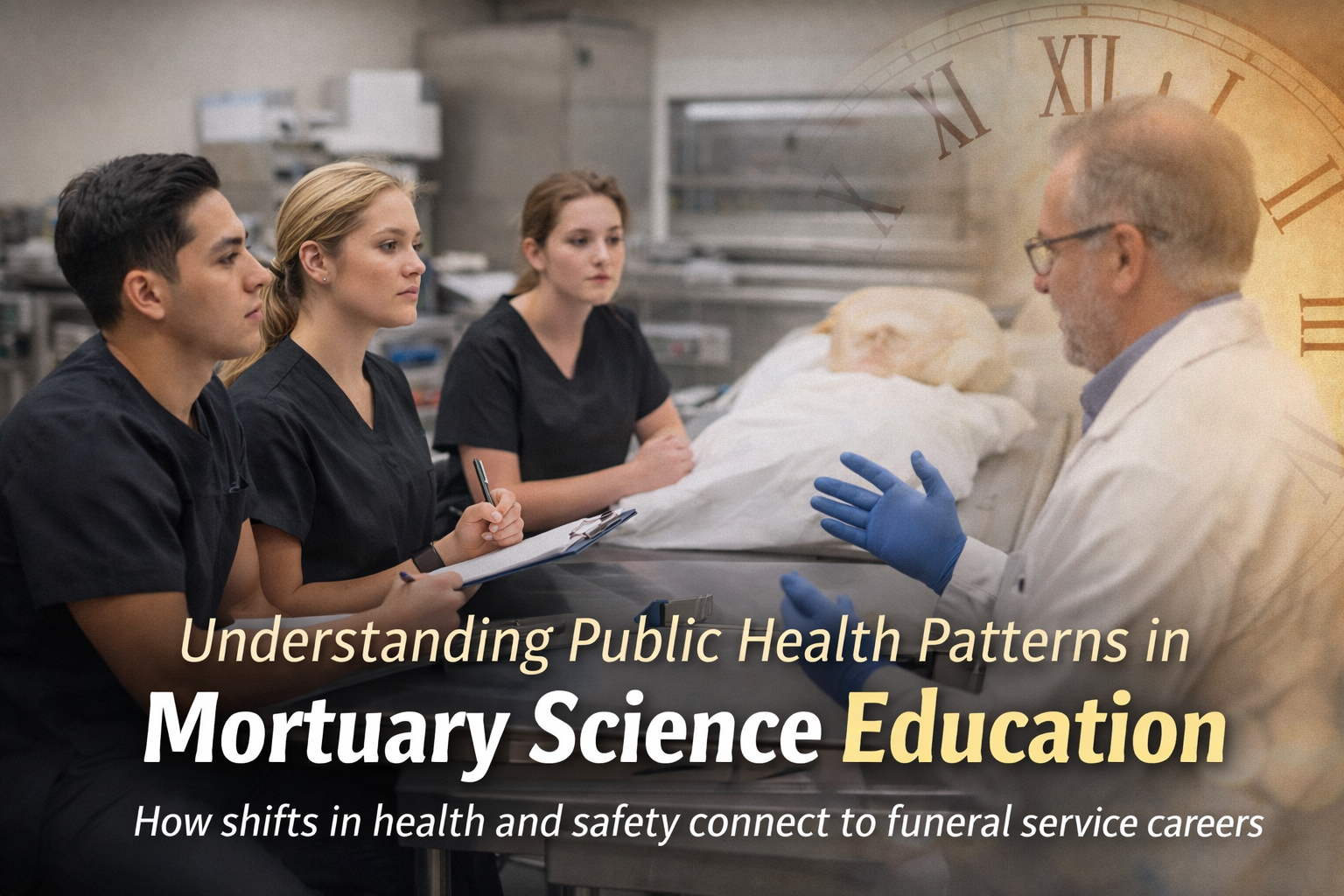
One of the most important professional lessons in funeral service education is that case flow does not exist in a vacuum. Workload can be influenced by seasonal illness, severe weather, heat-related events, influenza outbreaks, transportation incidents, and other health-related or environmental conditions. Daylight saving time belongs in this discussion because it provides a concrete example of how a public health pattern may produce short-term operational effects.
Short-Term Changes in Case Activity
Funeral homes are built to serve communities consistently over time, but the timing of cases can still fluctuate. If a hospital system, emergency department, or coroner’s office sees a temporary rise in certain types of sudden deaths or fatal accidents, that increase may influence how quickly cases move through the broader system. Funeral directors and mortuary staff may need to respond to more calls within a compressed period, even if the total change is relatively modest.
For students, the educational value lies in understanding that even a slight increase in case activity can affect staffing, transportation planning, communication timelines, and preparation room workflow. Funeral service professionals must be ready to adapt while maintaining dignity, accuracy, and calm for the families they serve.
Pressure on Medical Examiner and Coroner Systems
Not every death moves directly into funeral home care. Some cases require investigation, review, or authorization by a coroner or medical examiner. Accidental deaths, sudden unexpected deaths, and certain medical circumstances can delay release while officials complete required procedures. When outside systems experience a rise in workload, funeral homes may feel the effect indirectly through slower releases and shifting preparation schedules.
That reality is a valuable topic in mortuary science education because it reinforces the importance of interagency awareness. Students need to understand how funeral service intersects with legal and investigative processes, and how those processes influence timing, communication, and family expectations.
Operational Readiness and Scheduling
Funeral service is a profession that depends on precision and flexibility. Removal staff, directors, embalmers, and administrative teams all work within schedules that can change quickly. Daylight saving time offers a reminder that timing itself can become a practical issue. Overnight shifts, first calls, transportation coordination, and documentation accuracy all become more important when time changes affect systems and routines.
Students who learn to think operationally are better prepared for real practice. They understand that a successful funeral home is not defined only by compassion, but also by preparedness, consistency, and the ability to manage changing circumstances professionally.
Why Funeral Service Students Need a Broad Professional Perspective
Mortuary science is often misunderstood by those outside the field. Many assume it is limited to embalming techniques, arrangement conferences, or ceremony planning. In reality, funeral service is interdisciplinary. It includes science, law, ethics, psychology, communication, business operations, and public health awareness.
That is why a topic like daylight saving time belongs in a larger educational conversation. It helps students recognize that funeral professionals must interpret and respond to patterns in the world around them. They need to understand not only what to do, but also why systems behave as they do and how to respond when those systems are under pressure.
A well-prepared student learns to ask important professional questions. How might an increase in accidental deaths affect release times? What should a funeral director communicate to a family if investigative processes delay arrangements? How should documentation be reviewed when timing is especially important? What staffing decisions help a funeral home remain responsive while maintaining quality standards?
These are the kinds of questions that shape professional maturity. They move education beyond memorization and into judgment, leadership, and service.
The Relationship Between Accuracy, Documentation, and Professional Trust
Funeral service depends on public trust. Families expect funeral professionals to care for their loved ones with dignity, maintain accurate records, follow legal requirements, and provide guidance during emotionally difficult moments. Administrative precision is therefore not secondary to service. It is part of service.
Daylight saving time offers an instructive example of why timing and record accuracy matter. Overnight clock changes can complicate chronology and raise questions about exact times in medical, investigative, or transportation settings. Even when systems are designed to manage those changes, funeral professionals still benefit from understanding how timing can affect records, case movement, and communication.
In mortuary science education, students should be trained to value accuracy as a professional principle. Attention to detail in authorizations, permits, death certificates, transfer records, and scheduling protects not only the funeral home, but also the family’s experience. Precision supports confidence, and confidence strengthens trust.
What This Means for Students Considering a Mortuary Science Degree
Students interested in funeral service often feel drawn to the profession because it combines meaning with responsibility. They want to serve families, support communities, and make a difference during some of life’s most difficult moments. Those motivations matter. But students should also understand that funeral service is an intellectually serious profession that requires discipline and a strong educational foundation.
A mortuary science degree is about more than entering a meaningful career. It is about learning to operate within a field where science, law, care, and logistics intersect every day. The best funeral service education helps students build both technical competence and professional perspective.
That broader perspective is especially important for students researching terms like mortuary science school, mortuary science degree, funeral service education, and how to become a funeral director. These students are not just looking for a credential. They are looking for a pathway into a respected profession that requires readiness, resilience, and high standards.
Educational programs should reflect that reality. They should prepare students to understand the science of postmortem care, the legal structure surrounding death and disposition, the practical realities of funeral home operations, and the human dimension of guiding families through loss. That combination is what transforms training into professional preparation.
How Pierce Mortuary Colleges Prepares Students for Real-World Funeral Service
At Pierce Mortuary Colleges, funeral service education is connected to the realities students will encounter in practice. That includes the technical side of mortuary science, but it also includes the broader context in which funeral professionals work. Students benefit from learning how healthcare systems, investigative offices, documentation requirements, and public health trends affect everyday operations in the profession.
This kind of preparation matters because funeral service professionals are expected to do far more than complete individual tasks. They must make sound judgments under pressure, communicate clearly with families and institutions, adapt to changes in timing or case flow, and preserve the dignity of the deceased at every stage of care.
Strong funeral service education should help students build confidence in all of these areas. It should prepare them to step into the profession with the knowledge and professionalism needed to serve communities well. Pierce Mortuary Colleges is committed to helping students develop that foundation through education that respects both the tradition and the complexity of the field.
A Stronger Understanding of How to Become a Funeral Director
Students often begin with a simple question: How do I become a funeral director? The answer includes education, licensure requirements, practical training, and a commitment to professional standards. But it also includes something less obvious: the development of judgment.
Funeral directors must understand people, procedures, laws, documentation, timing, and community expectations. They must support families while also coordinating with hospitals, clergy, cemeteries, crematories, coroners, medical examiners, and regulatory systems. That is why funeral service education should go beyond isolated instruction and prepare students for the complexity of actual professional life.
Topics like daylight saving time reinforce that broader view. They help students understand that the funeral profession responds to patterns larger than itself. Learning to see those connections is part of becoming a capable funeral director, embalmer, or mortuary professional.
A Small Time Change, A Larger Professional Lesson
Daylight saving time may appear to be a modest change on the calendar, but it points to a much larger truth. Funeral service professionals work in a field shaped by public health, legal procedure, institutional timing, and community needs. Their work requires empathy, but it also requires analysis, adaptability, and discipline.
For students considering a future in this profession, that is part of what makes the field so meaningful. Funeral service is not passive work. It is skilled work. It calls for people who can respond thoughtfully, maintain standards under pressure, and provide steady guidance during some of the most important moments in a family’s life.
At Pierce Mortuary Colleges, students can prepare for that calling through an education designed to support professional growth, technical competence, and a clear understanding of the realities of modern funeral service. That is the value of an excellent mortuary science education, and that is why topics like daylight saving time can become powerful teaching tools in the classroom and compelling points of connection for future students.
Want to learn more?
Explore Mortuary Science Education at Pierce Mortuary Colleges
If you are looking for a mortuary science school that prepares students for the real demands of funeral service, Pierce Mortuary Colleges offers an education grounded in professionalism, service, and practical knowledge.
Learn How to Become a Funeral Director
Discover how funeral service education can help you build the knowledge, judgment, and skills needed for a meaningful career serving families and communities.
Take the Next Step
Request information, explore program options, and see how Pierce Mortuary Colleges at pierce.edu We can help you begin your path toward a career in funeral service.