Environmentally Friendly Funeral Services & Green Burial: What Families Are Asking for Now
Something has shifted in the arrangement conference. Families still ask about burial or cremation—but increasingly, they follow with a different question:
“What are the environmentally friendly funeral service options?”
This is not a fringe request. It reflects a broader cultural movement toward sustainability, transparency, and values-based decision-making. As environmental awareness grows, families want funeral services that align with the way they lived.
What “Environmentally Friendly Funeral Services” Actually Means
The term environmentally friendly funeral services can sound simple. In practice, it encompasses a series of interconnected decisions involving body preparation, materials, cemetery requirements, and memorial design.
Green funeral service is not one product—it is a philosophy applied across the entire process. And families are increasingly arriving informed, expecting funeral professionals to explain those distinctions clearly.
Key Elements of Green Burial
- Natural burial without chemical embalming when possible
- Biodegradable caskets or burial shrouds
- Reduced use of vaults or liners where cemetery regulations permit
- Land stewardship and conservation-focused burial grounds
Dallas Institute of Funeral Service highlights the growing need for proficiency in green funeral services, including biodegradable coverings and non-chemical preparation methods.
Read their discussion here.
Types of Green Burial Families Request
When families ask about green burial or environmentally friendly funeral services, they are rarely asking for a single standardized product. They are asking for clarity. They want to understand the practical differences between available options—and how those choices align with their environmental values.
In arrangement conferences across the country, three primary categories emerge repeatedly.
Natural Burial
Natural burial is the most commonly requested form of green burial. At its core, it emphasizes minimal environmental disruption and natural decomposition. Families choosing this option often prioritize:
- Avoidance of chemical embalming when possible
- Use of biodegradable caskets, wicker containers, or burial shrouds
- Elimination of concrete vaults or metal liners where cemetery regulations allow
- Simplified graveside rites in natural surroundings
What many families do not initially realize is that natural burial requires logistical coordination. Timing, transportation, refrigeration, cemetery policy, and documentation must all align. A funeral professional must understand both the science of human decomposition and the regulatory framework governing disposition.
For students in the Associate of Applied Science in Funeral Service program at
Pierce Mortuary Colleges, these considerations are not abstract. They are part of the foundational education that prepares graduates to guide families responsibly.
Conservation Burial
Conservation burial extends the principles of natural burial by linking disposition with long-term environmental stewardship. In these settings, burial grounds are often managed with conservation goals in mind—preserving open land, protecting ecosystems, or maintaining native landscapes.
Families who select conservation burial are frequently motivated by a desire for permanence that extends beyond memorialization. They see the burial site not only as a resting place, but as protected land.
From a professional standpoint, conservation burial demands detailed communication. Funeral directors must explain:
- Land management policies and access rules
- Marker restrictions or natural memorialization practices
- Long-term stewardship commitments
- How conservation goals intersect with cemetery operations
This level of service requires both ethical literacy and technical understanding—skills developed through comprehensive funeral service education.
Hybrid Green Cemetery Sections
In many regions, fully dedicated natural or conservation cemeteries may not be available. Instead, families encounter hybrid cemeteries—traditional cemeteries that offer designated green sections.
On the surface, this appears straightforward. In practice, policies vary widely. Some hybrid cemeteries allow biodegradable caskets but still require specific burial liners. Others restrict grave decoration or mandate certain depth standards.
This is where professional training becomes critical. Funeral professionals must verify cemetery requirements before presenting options, ensuring that “green” is accurately defined—not assumed.
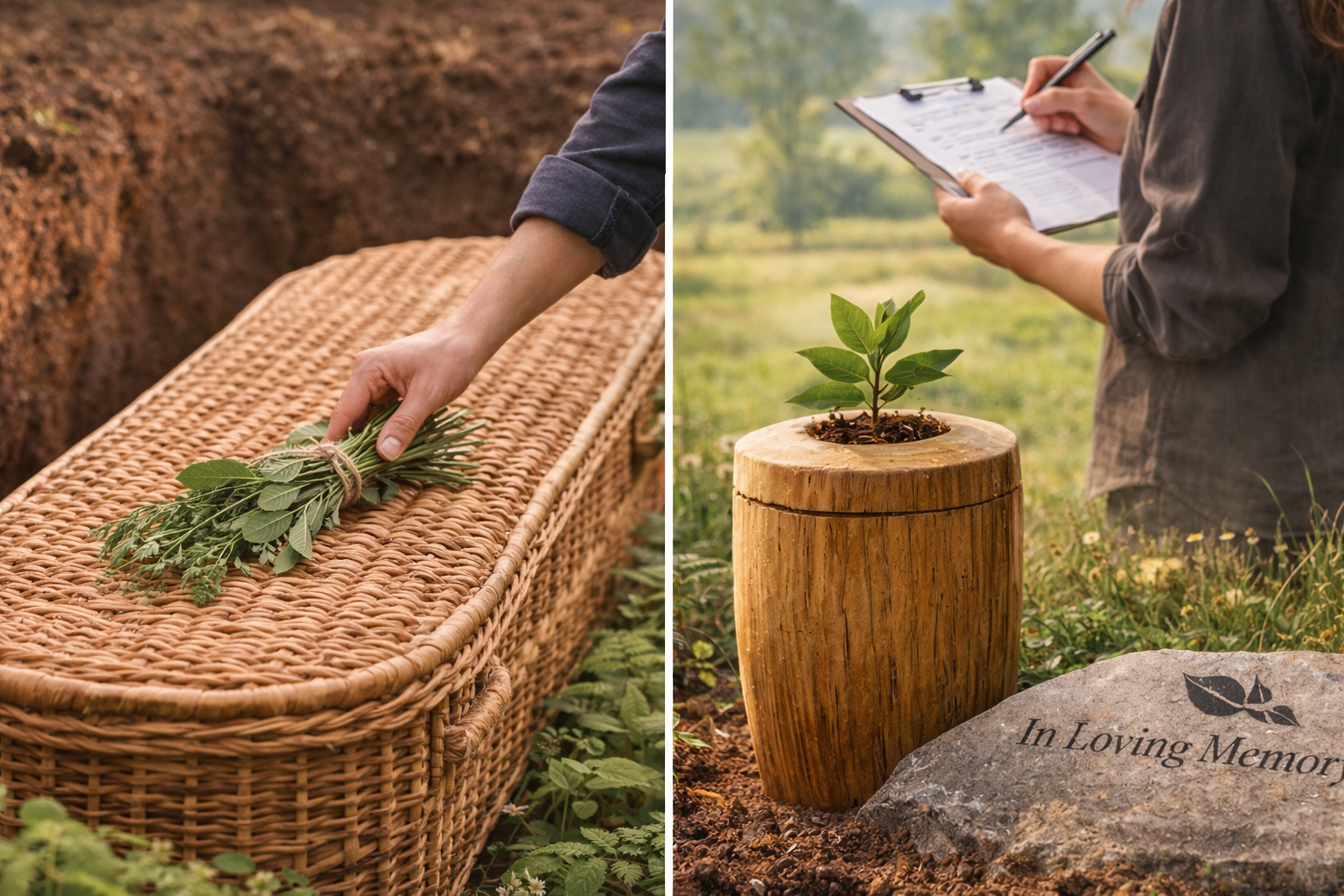
Natural burial and biodegradable memorial options reflect growing interest in environmentally friendly funeral services.
Eco-Friendly Funeral Services Beyond Burial
While green burial receives significant attention, eco-friendly funeral services encompass a broader spectrum of practices. Sustainability can influence the entire funeral experience—from preparation to memorialization.
Home Funerals and Vigils
Interest in home funerals and family-led vigils has grown alongside green burial conversations. Mid-America College of Funeral Service addresses this shift directly, noting increasing consumer demand for home-based rites and footprint-conscious options.
See their course overview.
Home-centered services can reduce facility use and allow families to participate more directly in care and ritual. However, they also require strict adherence to legal documentation, transportation requirements, and public health standards.
Professionals trained through accredited programs—such as the AAS program at Pierce Mortuary Colleges—learn how to balance family-centered flexibility with regulatory compliance.
Biodegradable and Sustainable Memorial Products
Families increasingly ask detailed questions about merchandise:
- Are the caskets sustainably sourced?
- Is the urn biodegradable?
- What materials are used in interior linings?
- Can printed materials be minimized or replaced digitally?
Biodegradable urns, natural fiber shrouds, reduced-resource memorial stationery, and simplified service structures all fall under the umbrella of environmentally friendly funeral services.
The investigative reality is this: sustainability claims must be explained carefully. Funeral professionals who understand materials, sourcing, and cemetery compatibility provide families with clarity instead of marketing language.
That level of competence begins in the classroom and laboratory. Students pursuing the
Associate of Applied Science in Funeral Service at Pierce Mortuary Colleges gain the scientific foundation, ethical grounding, and practical training needed to navigate these evolving expectations.
Why Education Matters More Than Ever
The rise of green burial and environmentally friendly funeral services creates both opportunity and responsibility. Funeral professionals must understand:
- Legal and regulatory considerations
- Cemetery policy variations
- Ethical communication regarding environmental claims
- Scientific principles behind preparation and disposition
Pierce Mortuary Colleges recognizes that the future of funeral service includes sustainability, innovation, and informed service.
Learn how PMC prepares students.
Prepare for the Future with the Associate of Applied Science in Funeral Service
If you want to enter a profession that blends science, service, ethics, and evolving environmental awareness, the
Associate of Applied Science in Funeral Service at Pierce Mortuary Colleges provides the academic foundation and professional preparation to lead.
Families are already asking for environmentally friendly funeral services. The next generation of funeral professionals must be ready with accurate information, practical skills, and confidence.
Explore the Associate of Applied Science (AAS) in Funeral Service at Pierce Mortuary Colleges